
Routes, refusals and the rules that apply once a parcel leaves
Route prices live behind a sign-in, so this page covers what is published: how the picker behaves, what carriers refuse, and who carries which risk.

What the route picker shows, and when
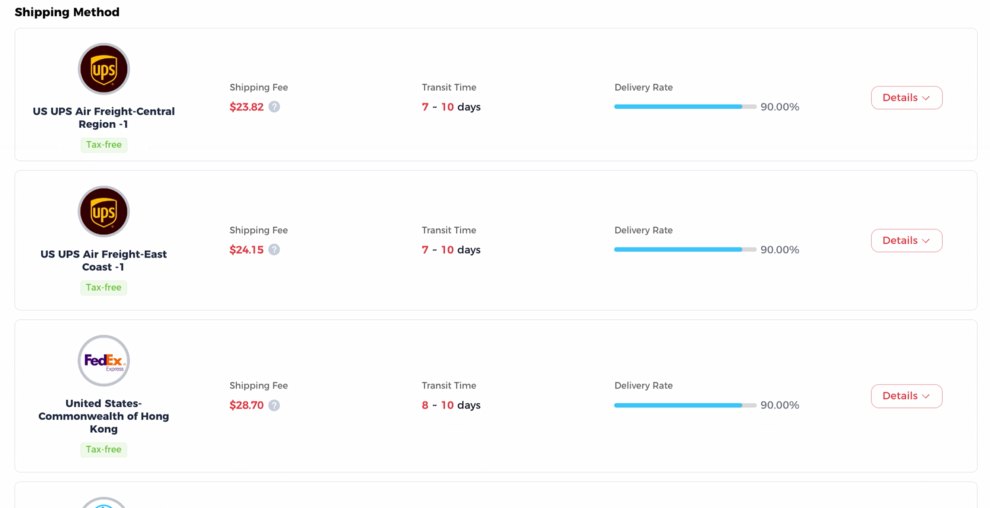
Routes are not a published list. They appear inside an account, against a real parcel, once the destination and contents are known, and each line carries a price, a transit window and a delivery-rate figure. The public estimator page asks for the same inputs and then opens a sign-in dialog.
The one public look at that screen is the agent's own walkthrough video. In it the picker shows two air-freight lines and one express line to the same country, with transit windows of about a week to ten days, tax-free tags on each, and delivery rates shown as percentages.
Carrier marks in the site footer name an international postal service and two express carriers, and the home page claims coverage of more than two hundred countries and regions. No public price list sits behind any of it.
When one route appears, or none
The published guidance covers both cases plainly. A single available route means the address and the parcel match only one method, and the suggestion is to split a large parcel into smaller ones. No route at all usually means bulk, size, or a destination that sits outside the normal network, with island territories named as examples.
A parcel that was accepted and then bounced back to the warehouse is a third case. The published reasons are a cancelled route, a route that cannot reach the destination, or address details that failed a check, and the fix is to pick a new method rather than to wait.
Contents that carriers refuse
The mailing restrictions article is a long table, and most of it is the usual list of dangerous goods: compressed gases, flammable liquids, corrosives and similar. Two entries matter for shoppers rather than chemists.
Counterfeit and rights-infringing goods are listed as prohibited outright, and the platform statement on the service page puts it in one line: counterfeit goods are strictly prohibited. Separately, the signing notice says the warehouse can verify material and category but cannot determine whether something is genuine, and that a seizure on those grounds falls on the recipient.
Liquids are the quieter constraint. A bottle of fragrance in a parcel can remove routes that the same parcel would otherwise be offered, which is worth knowing before the parcel is built rather than after.
Duties, clearance and what is not covered
Duty and tax belong to the destination country: its rules, its rates, its collectors, and nothing the agent can adjust. The published compensation rules say so from the other direction: parcels seized because the recipient did not cooperate with clearance or did not pay what was owed are excluded from cover.
Remote-area surcharges work the same way. The published note is that the carrier applies them based on the delivery address and that the agent is not the one charging it.
The force majeure list is the usual one, and the practical part is the deadline: no enquiry or claim within seven days of signing, or forty-five days of dispatch, and cover lapses regardless of what happened.
Failed delivery, return and a second attempt
If a parcel cannot be delivered it goes back to an overseas warehouse, and the published fees for what happens next differ by region.
| Destination | Return fee | Second delivery |
|---|---|---|
| European Union and United Kingdom | 160 yuan | 160 yuan |
| United States, parcel under five kilograms | Free | 150 yuan |
| United States, parcel over five kilograms | Free | 250 yuan |
| Everywhere else | Free | 160 yuan |
Published redelivery table, read October 22, 2026. Declining the second attempt means paying any return fee and the parcel being destroyed.
Domestic returns inside China work differently again: a parcel bounced for a security check is resent free on the postal route, while other routes deduct the original shipping fee towards the resend and bill any difference.
Signing for it
The published advice is to check before signing, note any damage on the waybill, and refuse the parcel if the damage is obvious. If a signed parcel turns out to be short or damaged, keep the outer box and the tape, report it to the local carrier or post office within two days, and raise it with support within seventy-two hours.
After a normal signature the agent's stated responsibility ends. That sentence is the reason the two-day and seventy-two-hour numbers are worth remembering before the parcel arrives rather than after.
- Returns and claims The two clocks, with the published figures.
- Weight that gets billed Why the deposit and the final bill differ.
- What you pay for Every charge in one place.